How to Price Flowers: The 3.0x Markup Formula Every Florist Needs — Free Calculator
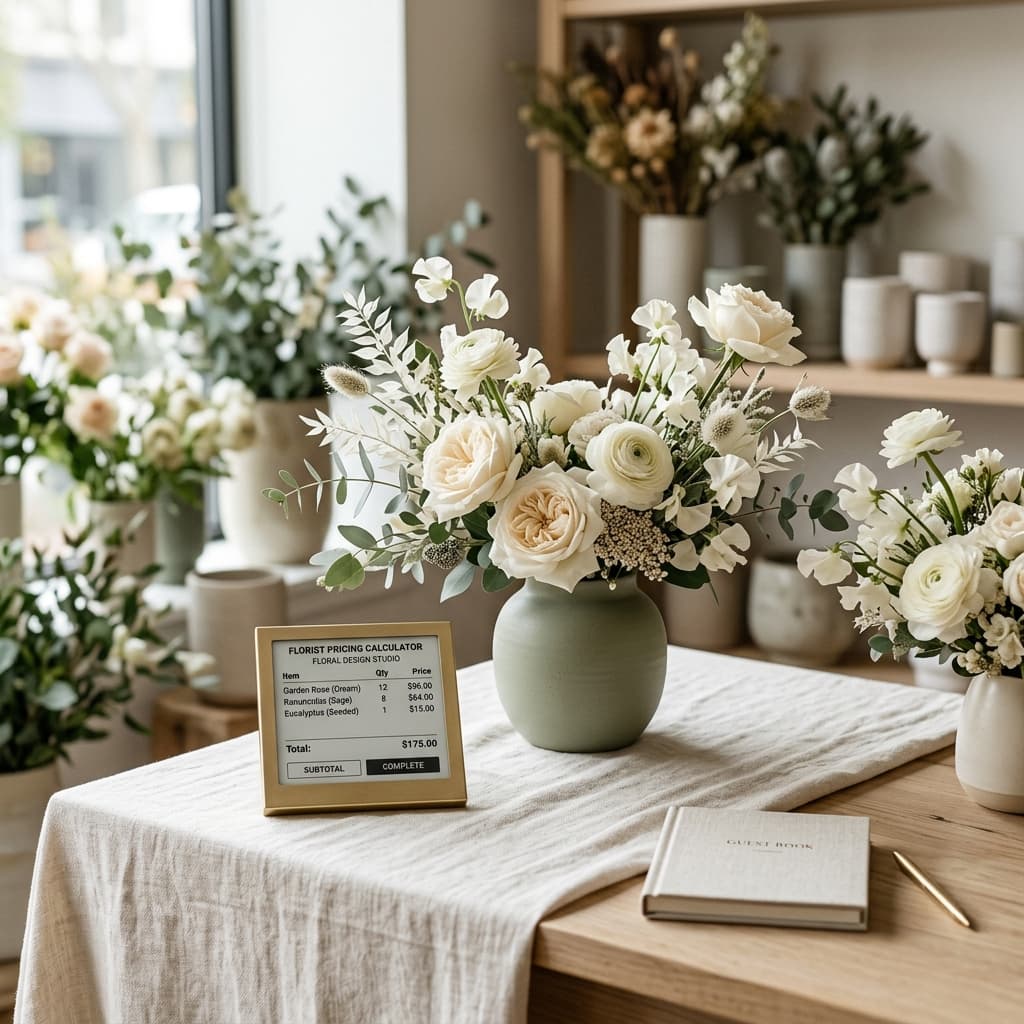
Stop guessing your flower prices. Use the industry-standard 3.0x markup formula: (Cost + Labor) × 3.0. Includes a free online margin calculator for florists.
The standard floral pricing formula is Retail Price = (Total Material Cost + Labor) × 3.0, where one third covers wholesale flowers and hard supplies, one third covers fixed shop operating overhead, and the remaining third delivers healthy net profit while factoring in an industry-average 15% flower shrinkage rate.
The Problem with Intuitive Markup
Many flower shop owners calculate prices by adding 50% or 100% to the cost of flowers. For example, they buy a bundle of 25 Freedom roses for $50 and figure each rose costs $2. Using 12 roses in a bouquet, they assume $24 in cost, add 100% and sell it for $48.
This formula guarantees business failure over time for several reasons:
- Ignores operational shrinkage. You rarely use all 25 roses from a bundle. Stems break or arrive with botrytis (fungus). Real shrinkage ranges from 12% to 18%.
- Omits hard goods costs — floral foam (OASIS), preservative, floral tape and wrapping paper.
- Doesn't account for fixed overhead — rent, electricity for the cooler, software, marketing.
- Completely ignores the designer's time and labor.
The 3.0x Markup Rule
The international standard in retail floral management is the triple multiplier (3.0x). This means the retail selling price should be three times the total wholesale cost of the arrangement.
The pricing structure breaks down as follows:
- First third (33%): Covers the exact cost of materials (flowers, foliage, containers, supplies) and design labor.
- Second third (33%): Absorbs fixed operating costs (rent, utilities, software, marketing).
- Last third (33%): Represents net business profit before taxes.
Retail Selling Price Formula:
Selling Price = (Total Material Cost + Labor) × 3.0
Step-by-Step Pricing Example
Let's price a classic centerpiece using hydrangeas and roses.
Step 1: Direct Material Cost
Sum the wholesale price of each element used, including exact fractions:
- 3 White Hydrangeas ($12 each) = $36
- 5 Vendela Roses ($4 each) = $20
- Eucalyptus cinerea foliage (1/4 bunch) = $5
- White ceramic container = $15
- 1/3 block of OASIS floral foam = $3
- Total materials: $79
Step 2: Labor Charge
The industry applies a 20% to 30% surcharge on total materials for design and assembly. For this standard centerpiece, we'll apply 20%.
Labor (20% of $79) = $15.80
Total wholesale cost ($79 + $15.80) = $94.80
Step 3: Apply the Retail Multiplier
Multiply the total wholesale cost by 3.0 to get your display or retail price.
Retail Price = $94.80 × 3.0 = $284.40 → Rounded to $285
When to Adjust the Multiplier
The 3.0x rule is the baseline, but certain situations warrant adjustments:
- High-risk perishables (peonies, garden roses): Use 3.5x to 4.0x to account for higher shrinkage rates.
- Hard goods (vases, planters): Use 2.0x to 2.5x since there's no spoilage risk.
- Wedding & event work: Use 3.5x or higher to factor in consultation time, delivery logistics and setup labor.
- Holiday rush (Valentine's, Mother's Day): Wholesale prices spike 30-80%. Maintain your multiplier on the inflated cost — customers expect premium pricing on peak dates.
Automate Your Pricing with FloristApp
FloristApp's built-in cost tracking automatically calculates your material cost per arrangement. Combined with the margin simulator, you can set retail prices with confidence and track your actual gross margin in real time — no spreadsheets, no guesswork.
Frequently Asked Questions
What is the standard markup multiplier for pricing flowers?
The international standard in floral retail management is 3.0x on total wholesale material cost plus labor. One third covers materials, another third covers overhead, and the last third is net profit.
How do you calculate flower shrinkage into cost?
Operational shrinkage typically ranges from 12% to 18% of flower cost. This percentage should be included in direct cost before applying the retail markup multiplier.
Should you apply the same margin to fresh flowers and expensive vases?
For perishable fresh flowers, a 3.0x to 3.5x markup is recommended due to wilting risk, while hard goods like crystal vases typically use a 2.0x to 2.5x multiplier.
Streamline your flower shop operations today
Join florists automating orders, custom bouquet building, in-store POS, and shrinkage tracking with FloristApp.